Silicone Moulds for Decorative Plaster

Bespoke Silicone Mould Making

Flexible silicone moulds taken from original cornice enrichment, ceiling roses and ornamental plaster, so missing or damaged detail can be cast to match what is already in the room.

Silicone mould taken from decorative plaster ornament

Why silicone moulds are used in plaster restoration

When a length of enriched cornice or part of a ceiling rose has been lost, the most faithful repair comes from the surviving original. A silicone mould taken from an intact section reproduces the ornament exactly, including the depth, crispness and small irregularities of hand-modelled work that a catalogue substitute will not have.

Silicone is used because it is flexible. Leaf enrichment, egg and dart, acanthus brackets and deeply undercut rose petals would lock into a rigid mould; silicone peels away from the cast without breaking fine edges, and the mould can be used again for every repeat needed along a wall or around a room.

Larger or floppier moulds are supported by a rigid outer case, sometimes called a mother mould or jacket, so the silicone holds its shape while the plaster is poured and sets. Casts are then cleaned up, fixed and jointed into the existing work.

It is worth being clear about the limits. Plain run cornice, the continuous profile with no ornament, is not normally cast. It is reproduced by cutting a zinc template to the exact profile and running it in plaster, either in place or on the bench. Silicone moulds come in where there is repeating or modelled ornament that a running template cannot form.
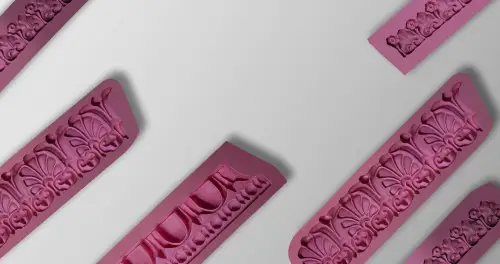
What we make moulds from

Cornice enrichment

Egg and dart, dentils, bead and reel, leaf and flower runs. A mould is taken from a clean repeat so missing lengths can be cast and set into the run cornice.

Ceiling roses

Whole roses, or a single segment of a symmetrical rose where only part of it survives, so the damaged sections can be recast and rebuilt.

Brackets, corbels & ornament

Modillions, consoles, corner blocks, paterae and other individual pieces that need to be repeated or replaced to match.

How a bespoke mould is made

  1. Assess the original. We look for the best surviving section: the least damaged, with the least paint build-up hiding the detail.
  2. Clean and prepare. Old distemper and paint layers soften ornament badly, so the source is cleaned back where possible and sealed with a release agent.
  3. Take the mould. Silicone is applied over the ornament and, where needed, backed with a rigid case to keep its shape.
  4. Cast and check. A trial cast is taken and compared against the original before the run of casts is produced.
  5. Fix and finish. Casts are fixed, jointed and stopped in so the repair reads as part of the original scheme.

Getting a quote

The quickest way to price mould work is from photographs. Please send:

  • a close-up of the ornament you want reproduced
  • a photo showing the damaged or missing area
  • a wider view of the room or ceiling
  • rough measurements, or a tape measure in shot

Let us know whether you need the mould itself, casts from it, or the full repair carried out on site.

Send photographs

Ready-made moulds

Using one of our silicone moulds

If your detail matches a standard design, a ready-made mould may be all you need. This short video shows one of our silicone moulds being used to cast a plaster decoration.

Browse ceiling rose silicone moulds or ornate coving and cornice silicone moulds.

FAQ

Can you make a silicone mould from my existing cornice or ceiling rose?
Usually, yes. A mould can be taken from an intact section on site, from a loose piece that has come away, or from a sample removed for the purpose. The cleaner and more complete the original, the better the cast.

Is a silicone mould always the right way to match cornice?
Not always. Plain run cornice is normally reproduced with a profile template run in plaster. Silicone moulds are used for cast ornament such as egg and dart, dentils, leaf enrichment, ceiling roses, brackets and corbels.

What can be cast in a silicone mould?
For restoration work the usual casting material is plaster, to match the original. Silicone moulds also suit many resins and other casting materials, but the right choice depends on where the piece will be fitted.

Do you sell ready-made silicone moulds?
Yes. Ready-made silicone moulds for ceiling roses and ornate coving and cornice enrichment are available from our online collections.

Need a mould made from your original plasterwork?

Send photographs of the ornament and the damage, and we will advise on the mould, casts or full repair.